
Description
What is included?
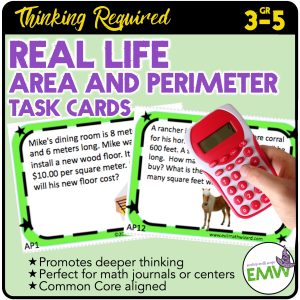
1 pdf file with 15 pages
- 5 pages with four area and perimeter tasks on each page (landscape)
- 2 page answer key
- 3 page student answer sheet (for drawing/thinking)
- 2 page student tracking
- 1 page of blank cards to add your own
- 2 pages for cover and copyright info
Example task:
A rectangular dining room has a perimeter of 44 feet and the walls are ten feet high. A gallon of paint covers about 350 square feet. What are the possible lengths and widths of the room? How much paint will you need to buy?
Note: Uses US customary and metric measurement.
How can I use this product?
The cards can be used as a math center. I have used these as prompts for their math journal or in a Scoot game. Students can do two a day for a whole week.
What are teachers saying?
“Great extension activity option for my top mathematicians. Thank you for including metric measurement cards so I was able to use in my Australian classroom.” — ABibby
“This was a great review. They still need work with both of these concepts and it provided a new way to present practice instead of the same old worksheets.” — Collabor8
What standards are addressed?
Common Core Standards
3.MD.5. Recognize area as an attribute of plane figures and understand concepts of area measurement.
- A square with side length 1 unit, called “a unit square,” is said to have “one square unit” of area, and can be used to measure area.
- A plane figure which can be covered without gaps or overlaps by n unit squares is said to have an area of n square units.
3.MD.6. Measure areas by counting unit squares (square cm, square m, square in, square ft, and improvised units).
3.MD.7. Relate area to the operations of multiplication and addition.
- Find the area of a rectangle with whole-number side lengths by tiling it, and show that the area is the same as would be found by multiplying the side lengths.
- Multiply side lengths to find areas of rectangles with whole- number side lengths in the context of solving real world and mathematical problems, and represent whole-number products as rectangular areas in mathematical reasoning.
- Use tiling to show in a concrete case that the area of a rectangle with whole-number side lengths a and b + c is the sum of a × b and a × c. Use area and perimeter models to represent the distributive property in mathematical reasoning.
- Recognize area as additive. Find areas of rectilinear figures by decomposing them into non-overlapping rectangles and adding the areas of the non-overlapping parts, applying this technique to solve real world problems.
3.MD.8. Solve real world and mathematical problems involving perimeters of polygons, including finding the perimeter given the side lengths, finding an unknown side length, and exhibiting rectangles with the same perimeter and different areas or with the same area and different perimeters.
7.G.4 Solve real-life and mathematical problems involving angle measure, area, surface area, and volume.


Reviews
There are no reviews yet.