 I am often asked, “What does math look like in your classroom?” So I am going to record here what I do every day, from the start of a topic to the end. Today we kicked off a new math topic, Place Value. We just finished Fact Families, so you will see a bit of review as we transition. Okay here we go!
Wait! Freeze! Before we get going, here is a bit of background. I will be talking about my combined 2-3 grade class. Now before you click that little X in the upper right corner, thinking this has nothing to do with your class, remember that most 2nd grade classes have kids learning at a third grade level (or at least should have the opportunity to). And in 3rd grade classes, there are some students who are learning at a 2nd grade level (and should be supported). I have about 70 minutes a day, four days a week. Okay now we are ready to go.
The students come in for math after a twenty minute outdoor recess.  During this recess I have “inspectors” set up the appropriate math materials before they go out to recess. And in today’s case, they spread out the students’ folders on the gathering rug, set up the VersaTile station, and the Task Card station, as well as the Activities stations (details coming below). This gives me a chance to have a bit of a break myself as well as have time to prepare for this math session. I have a whiteboard that tells them what to do to get set up when they come in for recess.
  This also allows me a couple more minutes in case I am not quite ready (copy machine broken), or I am stuck in a conversation, or I need to finish my snack (aka go to the bathroom).
So they get their folder from the rug and choose a station to start, by putting their folder there along with a pencil. Then they move to our gathering rug and look at the question I pose on the whiteboard. They are free to talk about it with a neighbor. As we are finishing up Fact Families, I just put a simple Fact Family review. We are not going to spend too much time on this as we have already spent the last two weeks, its just a easy way to get them into math mode.

How I have the kids fill this out – I have all their names printed on a separate popsicle stick and I randomly choose a stick/name and have that student come up to the whiteboard and fill in one of the fact families. While they have started I call out another name. So two people are up at the same time. When one person is done, I call out another name, and they hand their marker to them and they come up. (Or I have done it when they hand their marker to whoever has their hand up). I wanted to make sure everyone had a chance to do this today though. Note: With two people up at a time, it takes pressure off as not all the focus is on one student standing up in front of everyone.

So after all the Fact Family chart is filled out, we go over the planner. Everyone has their own planner in their math folder. The planner lists the stations they need to go to this week. I adjust the planner stations according to the needs of the students. So I dismiss most of the students to go their station, but I have strategically not called people who could use some more conceptual knowledge of place value. Now this is when it gets fun.
I have a clear 2 cup measuring cup that is about 1/4 of a cup filled with rice. I just have it in my hand casually, while I have dismissed the first group. So the students on the rug are waiting for me to dismiss them to their station, and we are waiting for the other students to get settled. While we are waiting I am explaining that I counted the rice in the cup for a science experiment we were doing in the afternoon, s omething about creating a model of soil content. Anyway, I go over to help a student get settled, and I “trip” and the rice falls all over the rug. Of course, they immediately want to help me clean it up, which I said super, but I had counted the rice for the science experiment. They start to count and of course students counting random piles of rice got really confusing. I let this go on for a couple of minutes until I sense some serious frustration.
I then ask if we should come up with a strategy to count the rice. Students offer their ideas, which was quite a variety. But one of the options someone mentions is to make piles of ten. Most students thought that would be the best idea and we talk about why that would be a good option. Everyone agrees so they st art. You know we got to almost 2000 pieces of rice and we were probably only 1/4 of the way? So if you do this too, use less rice or a bigger item. This took most of the math time for this group. But it was pretty powerful. I am planning on talking about our experience with the rest of the class tomorrow.
Meanwhile the other students were working at the other stations:
 Folder station
 Folder station
Each student has a math folder that has two sides: a To Do side and a Done side. This week in their To Do side, they had a Halloween Fact Family worksheet (freebie in my TPT store) as well as a couple of other worksheets depending on what skill they were working on. I have explained that in a previous blog, so click here.
VersaTile station
Each student needs to complete 3 of these a week, according to this week’s planner. It might adjust depending on what o ther stations they need to do that week. Here is a link to the VersaTiles I like. There are several different books at different levels, so each student has a couple of choices. And they are self correcting, so I don’t have to monitor them. The inspector signs them off.
Task Card station
This week we are reviewing Fact Families, so they have to do 5 task cards. This set of task cards is differentiated, so most of my 2nd graders will start with card one and my third graders will start at card 10 or 15.
Activity station: Place Value Toss
This week this station is for my third graders. With a partner they choose, they take turns tossing three chips into the three place value bins (hundreds, tens, and ones). They record the score.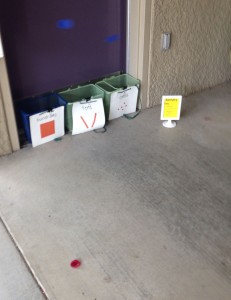 Do 8 or so rounds, and total up all the points. Second graders will do this next week. You can barely see the blue chips against the purple door.
Activity station: High Number Wins
This is also for my third graders. With a partner they choose, they each pick four number cards (from 1 to 9). They arrange them to make the highest number. For example, if a player draws a 1, 5, 3, 6, the highest number they can make is 6,531. They say the number to each other, write the number down, and the highest number wins. They do ten rounds.
Activity station: Race to 100
This is for my second graders. In a group of 3-4, they take turns rolling two dice. They take the appropriate amount of (fake) pennies. The object is to get to 100 first. They have a hard time keeping track of how many pennies they have and often have to recount on their turn. Eventually someone starts to make piles, groups, stacks, or rows of ten and others create their own realizing how it’s much easier to keep track. Now I don’t have enough pennies, so they have to think on how they can do this. Someone will mention dimes so we talk about swapping pennies for dimes and how much easier it is to count when we have one dimes instead of ten pennies.


Activity station: Place Value Picture
This is for my second graders. At a table for four I have a bin of base ten blocks (ones, tens, and hundreds). They are to make up a design using these blocks on a piece of paper. Then then trace around the blocks onto the paper. Total up the value and write it on the paper, as well as color in the design.
 The Rest of Math Time

Students can move freely from station to station as they finish or want a change. I spend most of my time discussing rice counting with mostly second graders.
Note: I use the cheap IKEA frames to designate the station locations. I laminated the card so I can write the name of the Activity on the front as well as the number of people allowed at that station. On the back I write what supplies they need to bring.
About five minutes before we dismiss for recess, we clean up. The inspectors make sure their stations get cleaned up as well. We gather on the rug and today I just asked them to name one thing they learned. I randomly call on people by choosing from my popsicle sticks.
Day 1 – Place Value Introduction
Day 2 – Place Value Making Groups Part 1
Day 3 – Place Value Making Groups Part 2
Day 4 – Place Value Tens and Hundreds
Day 5 – Place Value Up to Millions
Day 6 – Place Value Reading and Saying Numbers
Day 7 – Why Learn about Place Value
Day 8 – Place Value Beyond a Million
Thanks for reading!
PS – If you want to easily use some of these activities in your own classroom, I have a Place Value kit available on my Teacher Pay Teachers store.